Lifelong sexual exclusivity showed up in the last two percent of our time on this planet. It arrived with agriculture, spread with empire, and we’ve been calling it human nature ever since.
Years ago, sitting on the ground outside a village where I had been welcomed for a few weeks, I tried to explain my own culture’s arrangement to a woman who was easily the oldest person there.
I said that where I come from, a person chooses one partner. She nodded. I said they promise to be sexually faithful to that one person. She nodded again, waiting for the rest of it.
I told her there wasn’t any rest of it. That was the whole arrangement. One person, for life.
She laughed. Not unkindly, and not for long. Then she asked me how that was working out.
I have thought about her question for a very long time, mostly because I had nothing to say to her that afternoon and I am not certain I have much now. What I did eventually have was the research. It says something I would not have predicted before I sat on that ground.
Monogamy feels like human nature to many… but that feeling, however widespread, deserves a closer look.
By all of the best available evidence, Monogamy is about as unnatural as styrofoam. Lifelong sexual exclusivity as a social system emerged roughly five thousand years ago, among early agricultural groups in what is now central Europe. Homo sapiens has been around for about three hundred thousand years, practicing non-monogamy for all that time!
Do that arithmetic. Monogamy showed up in the last two percent of our time on Earth.
For the other ninety-eight percent, for roughly two hundred and ninety-five thousand years, humans were doing something else.
How it spread
Not by proving itself. Monogamy was codified into social law in ancient Greece and Rome, then exported across the planet in the cargo holds of colonization and on the strength of religious mandate. It travelled the way empires travel. And it travelled well, because it was solving a genuine problem, just not the problem we think. Monogamy is efficient at three things: preserving religious order, securing property inheritance through provable paternity, and controlling sexual behavior at scale. Every one of those is a governance concern.
None of them is love. Which is worth sitting with for a moment. The system we now treat as the highest expression of romantic devotion was originally an administrative solution to the question of who inherits the farm.
Where the evidence actually comes from
I want to be careful here, because “we’re not naturally monogamous” is the sort of claim people wave around without support. So here is the support, drawn from fields that don’t talk to each other and arrive at the same place anyway.
Start with the animal comparison. You’ll often hear that plenty of animals are monogamous, offered as though it settles something. But truly monogamous species are vanishingly rare, well under one percent of mammals, and among that tiny fraction, humans do not appear. Pointing at swans to explain human behavior isn’t science. It’s selective quotation (swans aren’t even consistently monogamous!).
Then there is the matter of how our bodies are built, and here’s a principle that rarely makes it into a biology class. Across mammals, the more visually different males and females are, the more likely the species is non-monogamous. Strictly monogamous species tend toward monomorphism, males and females nearly indistinguishable. Look at swans. Look at penguins. You genuinely cannot tell.
Now look at us. Human males average roughly 1.2 to 1.3 times the size of females and are meaningfully stronger. Fat distribution differs. Pelvic structure differs. Facial structure differs enough that you can usually sort a crowd from across a street.
This is what a species shaped by sexual competition and female choice looks like. Monogamous species don’t need the display, because they don’t need to compete.
Some will counter that our dimorphism is modest compared to gorillas, and therefore we’re basically monogamous. But that argument collapses the moment you look at actual monogamous species, where the sexes are nearly identical. Being less dimorphic than a gorilla doesn’t make us monomorphic. It makes us less dimorphic than a gorilla.
The ground has something to say about this too. Archaeologists have documented ancient high-status burials in which a single male is interred surrounded by multiple females. That’s not an anomaly at one site. It’s a pattern, and it indicates arrangements that were not merely tolerated but socially recognized and honored. Before we invented monogamy, high-status men had harems, and nobody thought it required an explanation.
Then the hormones, which are the least ambiguous part of the picture. Testosterone reliably amps up mating effort across mammals, humans included, more competition for mates, more partners. And there’s a curious developmental marker: the ratio between the index and ring fingers, set before birth, reflects prenatal testosterone exposure. Men whose ring finger is longer than their index finger were exposed to more of it, and research associates that pattern with stronger competitive drive and greater interest in multiple partners. Consistent with polygyny. Look at your own hand.
Bones, bodies, hormones, and the archaeological record. Four fields, no coordination between them, one conclusion: humans evolved in a context where higher-ranking, higher-testosterone males competed for mates, and successful males often reproduced with more than one female.
The “mildly polygynous” dodge
Some researchers prefer to call us mildly polygynous rather than simply polygynous, citing our moderate dimorphism and our behavioral flexibility. I understand the impulse. It sounds measured. But it’s a bit like describing someone who eats plants all week and steak on Saturday as mildly vegetarian. The label sounds softer. The behavior speaks for itself. Homo sapiens is a naturally non-monogamous species. Practicing social monogamy doesn’t change our design any more than sleeping through the night in a lit room makes us nocturnal.
What it was actually built to do
I want to state this plainly, because the softened version has been circulating for a century and it obscures the thing.
Monogamy is not a moral achievement. Failing at it is not a shortcoming. Monogamy is a social construct designed to preserve religious order, property inheritance, and sexual control. That’s the list. There isn’t a fourth item hiding behind it.
Once you see it that way, a lot of otherwise strange facts line up. Why paternity certainty mattered so much to the people writing the laws. Why adultery was historically prosecuted far more aggressively in women than in men, in nearly every legal system that prosecuted it at all. Why the institution arrived alongside agriculture, which is to say alongside the first moment in human history when a family could accumulate something worth passing down. Why religious authorities took such intense interest in what was happening in bedrooms. None of that is about intimacy. All of it is about property and order.
And yet we treat the arrangement as sacred, as though questioning it means questioning love itself. Those are not the same thing, and conflating them has been extraordinarily useful to everyone except the people living inside it.
Why this matters more than it sounds
If monogamy were our evolved nature, then every affair, every fading marriage, every quiet resentment at year seven would be a story about individual weakness. Millions of personal failures, occurring independently, all coincidentally taking the same shape.
But if monogamy is a five-thousand-year-old social technology imposed on a three-hundred-thousand-year-old animal, then the pattern isn’t a character flaw. It’s a design mismatch. And design mismatches don’t get solved by trying harder. They get solved by looking clearly at the design. Consider the strength of the evidence against it. People risk their families, their reputations, their careers, in some jurisdictions their freedom and their lives, and millions still stray, every single day. That is not a story about poor character. That is biology outvoting ideology, at scale, for five thousand years running.
One thing to notice
Most people feel nothing when told that humans are diurnal, or omnivorous, or social primates. Those facts don’t threaten anyone’s identity, so they go down easily.
But tell someone we’re not wired for lifelong sexual exclusivity and watch what happens. The tightening. The defensiveness. The immediate search for a counterexample.
That reaction is itself the most interesting data point in this essay. We don’t defend facts. We defend beliefs.
Which one is this? If you think a piece of this is wrong, the comments are the place. I’d rather have the strongest objection early than a thousand agreements. Which of the four does the least work for you?

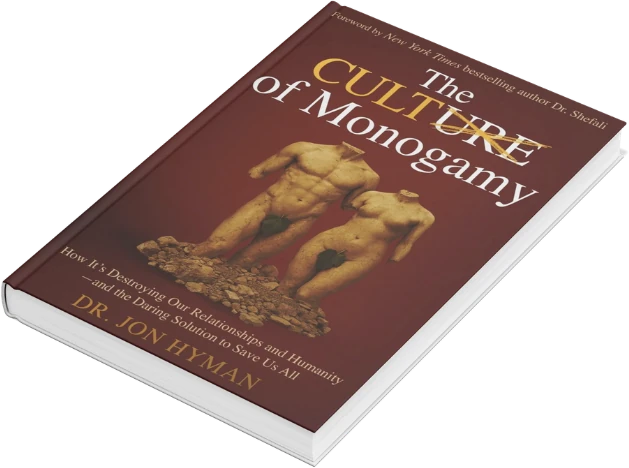
0 Comments